Two sewage treatment plants, a bicycle, and a spontaneous idea: During European Mobility Week, I swapped my car for a bicycle and experienced what sustainability really feels like in everyday working life. What began as an experiment turned into an inspiring journey that has permanently changed my thinking about business mobility.
In this article, I take you along on my tour, sharing practical insights, social background information, and personal experiences that may cause you to rethink your own mobility behavior.
European Mobility Week 2025: Steps toward sustainability
This year's European Mobility Week took place from September 16 to 22 and featured numerous events across the country. Educational institutions and local communities are involved in this project, whose main goal is to raise awareness among schoolchildren and the general public about the importance of sustainable mobility.
This year's theme was "Mobility for All." It highlights how quality of life depends heavily on how disadvantaged groups—such as people with disabilities—are included in our mobility. Their needs must be actively incorporated into the planning of public spaces. Taking this group into account automatically improves the mobility needs of all other user groups and promotes more inclusive, sustainable urban design.
Rethinking urban mobility: challenges and opportunities
In today's world, there is a particular need for the rational use of public land. In the past, we have focused too much on the needs of car mobility. A lot of space in public areas has been allocated to the construction of the necessary infrastructure, such as roads and parking lots. Today, we are finding that it is difficult to keep up with the needs of the growing number of private vehicle users. At the same time, we are using space in city centers for purposes that are not sustainable.
Modern cities need their own lungs, which means it is important to preserve and expand green spaces. Vienna recognized long ago how important green spaces are for protection against the summer heat and is considered a prime example among European capitals for implementing such projects.
In addition to structural changes, a change in mindset and mobility habits is particularly necessary. Those who have the opportunity should make greater use of public transport, bicycles, or walking—both privately and professionally. Only in this way will our cities become more sustainable and livable in the long term.
Personal experience: Cycling as a source of energy and well-being
During the COVID pandemic, I rediscovered the advantages of cycling as a means of transportation and experienced firsthand how positively outdoor exercise affects general mental and physical well-being.
Your thoughts become clearer and more structured. Emotionally, you become more resilient and can cope more easily with the daily challenges of your private and professional life. A natural need for continuous exercise develops, which you take to a higher level every year and which makes you more disciplined.
Over time, I began to participate in sporting events and set myself new goals. The body becomes more resilient and enduring. Well-being improves and you become an increasingly happy person.
Bicycle renaissance in Europe: from cars back to bikes
My personal rediscovery of the bicycle reflects a broader social change: after World War II, motorization increased rapidly in Europe. The car became a symbol of modern mobility and led to stagnation in the European bicycle industry in the 1980s. At that time, it was unusual to ride a bicycle in many places—in some cases, it was even considered shameful.
Today, the picture is completely different: in the face of pressing environmental problems, the bicycle industry is experiencing a renaissance. Suddenly, ideas are emerging on how to provide as many people as possible with fast, efficient, affordable, and sustainable mobility. A visible sign of this are the numerous city bike stations that can now be found on many street corners in almost every European city.
Folding bikes in business use: flexible mobility for customer visits
An indispensable type of bicycle in urban areas is the folding bike. It has been making a comeback since the 1970s and is now more popular than ever. With compact wheels (usually no larger than 20 inches), it is the ideal companion for train journeys, trips through shopping centers, or directly to the office, hotel, or customer visits. Its versatility makes it valuable for both vacations and business trips.
Modern folding bikes are significantly lighter and more user-friendly than earlier models. They are not a cumbersome burden, but rather a "Swiss Army knife" on two wheels: versatile, practical, and flexible. Since they can be easily transported when folded, there is no need to worry about theft.
In everyday working life, this flexibility proves to be a great advantage, especially when traveling on business.
In May 2024, for example, we took part in the IFAT international trade fair in Munich. For years, I have been taking my folding bike with me to such events, as we are usually located somewhere on the outskirts of the city. If time permits, I use it to explore the city and visit its sights. This way, I don't have to rely on public transportation to get around. Instead, my folding bike is always ready to go.
On two wheels to the sewage treatment plant: sustainability in customer service
But bikes aren't just useful at trade fairs; they can also be used for customer visits. During Mobility Week, I had a spontaneous idea: Why not do something in line with this year's Mobility Days in September? The decision was quickly made, and I announced my visit to two small central sewage treatment plants in my neighborhood. Our business partners welcomed the idea with enthusiasm when they learned that I would be visiting them by bike.
On the day of departure, everything was ready for the visit to the wastewater treatment plants in Pragersko and Rače. The weather cooperated, with sunshine as predicted, so I was able to equip myself optimally for the bike tour. As a passionate cyclist, I naturally planned the route in advance and calculated the length and course. I also paid attention to the type of surface I would be riding on – asphalt or gravel.
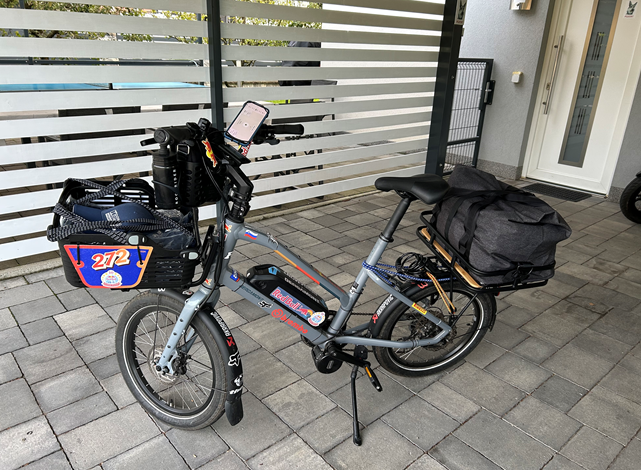
For the trip, I chose a compact bike that, although not foldable, can be easily loaded with luggage racks, baskets, and bags, making it ideal for longer rides. To be able to start the next morning without wasting any time, I had already packed the bike completely the evening before.
Loading a bike requires experience and common sense to avoid unpleasant incidents during the ride. It is particularly important to use original, high-quality fastening systems for baskets that guarantee a secure hold. The baskets on my bike can be quickly attached and removed using a click-click system. This allows me to save weight if necessary and keep the bike nice and light.
In addition to the right equipment, digital tools also play an important role. Nowadays, there are numerous apps that can be used to record travel time, distance, and much more. They not only make customer visits by bike more efficient, but also more measurable and easier to plan.
Final thoughts: Being a role model for sustainable business mobility
My business trip by bike during European Mobility Week is now behind me. As I mentioned at the beginning, my goal was to raise awareness of a sustainable mobility system and highlight its importance for the future.
Of course, not every journey can be made without a car. But wherever possible—whether by bike, on foot, or by public transport—and you have the choice: use a sustainable alternative! Become a role model for those who are still hesitant—and a companion to all those who already practice sustainable mobility.
There are also opportunities to exemplify sustainable mobility in everyday working life: in our professional mission, we are committed to clean waters and environmental responsibility – which inspires me to think: why not take a bike more often to the Slovenian coast, to Ljubljana, Gorenjska, Prekmurje, or Koroška? I park my car in a suburb where parking is free and cycle the last few kilometers to my customers. After my visit, I treat myself to a tour of the old town of a nearby city, drink a coffee, and then make my way home to Štajerska.
These are small steps, yes—but it's the
intention that counts. Right?
What is your next small step? I look forward to hopefully meeting you soon on your bike or elsewhere—guided by the idea that the experience of the journey itself is more important than the speed at which you reach your destination. Embark on your journey, take all the necessary safety precautions, and you will definitely reach your destination at the agreed time.
I would be delighted if you would share your experiences with me:
Office.Wassertechnik@donau-chemie.co