The Hohenems Region Wastewater Treatment Plant is one of the most efficient and technologically advanced plants in Vorarlberg. It serves a region of five municipalities (Hohenems, Götzis, Altach, Mäder, and Koblach) with around 50,000 inhabitants, treating around 6 million cubic meters of wastewater annually using efficient processes and renewable energies.
Hohenems: From municipality to city
Hohenems is a city with around 18,700 inhabitants in the district of Dornbirn in Vorarlberg. With the Diepoldsau Rhine canal and the Rhine regulation in 1923, the centuries-old flood risk was averted and the valley floor could be further settled. The specter of regular and devastating flooding of the valley floor lost its significance in Hohenems from 1923 onwards.
Large parts of the former floodplain were now converted into cultivated land. The Rhine silt provided the basis for fertile arable and pasture land for the farms.
The once small village was thus able to grow steadily into a town.
Its proximity to the border not only encouraged smuggling in the 1920s, but also provided an escape route to Switzerland from the Nazi regime between 1938 and 1945 – an escape that could mean the difference between life and death. The “Paul Grüninger Bridge,” named in 2012, commemorates one of the Swiss people who had helped numerous refugees.
The Hohenems economy benefited from this, especially from the 1950s onwards, when the period of the global economic crisis and the Second World War had been overcome. Its proximity to Switzerland in particular spurred this upswing. Today, Hohenems is home to a steadily growing number of successful companies covering a wide range of sectors.
Since 1969, Hohenems has been part of the newly founded district of Dornbirn. In 1983, on the occasion of the 650th anniversary of its town charter of 1333, the municipality was officially elevated to town status and has since been the youngest town in Vorarlberg.
Cultural highlights: Hohenems Palace, Schubertiade and Alt-Ems Castle, as well as the Jewish quarter with museum and café.
The townscape is dominated by Hohenems Palace, the former residence of the Counts of Hohenems. It is considered the most important Renaissance building in western Austria. The palace gained fame in the 18th century when two manuscripts of the Nibelungenlied were found in its library.
In 1976, the first Schubertiade took place in the palace, which developed into an internationally renowned music festival. Several museums were established in the surrounding area, including the Schubertiade Museum, which is dedicated to the composer Franz Schubert.
Another striking building is the Alt-Ems castle complex, located high above the valley, with seven gates, a drawbridge, and 47 rooms.
Built in the 12th century, the 800-meter-long complex was one of the most powerful castles in the entire region at the time. Its commanding position above the Rhine Valley gave the Hohenems knights an important position between the Habsburg Empire and the Swiss Confederation.
The Staufer fortress also served as a place of detention for prominent prisoners such as William III (Sicily) from 1195 and Archbishop Bruno of Cologne in 1206.
In 1407, the castle complex was destroyed in the Appenzell War and then gradually rebuilt into an extensive Renaissance fortress according to plans by Martino Longhi.
After the Counts of Hohenems died out, the castle passed to Austria in 1765 and was auctioned off for demolition in 1792.
Between 1938 and 1940 and again in 1965/66, the castle ruins underwent extensive restoration, and were renovated once more between 2006 and 2007. Today, the ruins are mainly privately owned by the Waldburg-Zeil-Hohenems family.
The walls of the palace and the base of the powder tower with its embrasures overlooking the Rhine Valley have been made visible again.
Jewish Quarter
The Jewish Quarter in Hohenems is an important historical ensemble that reflects the
city's centuries-long Jewish history and includes numerous
preserved buildings. Insights into this can be gained in the Jewish Museum with its adjoining café.
Leisure, Nature, and Sports in Hohenems
Thanks to its central location in the Rhine Valley, Hohenems is an ideal starting point for hikes, mountain bike tours, and winter sports. Popular destinations include the Schlossberg with the Alt-Ems ruins, the Hohe Staufen mountain with its panoramic views, the Alpe Gsohl, the Schuttannen area, and the Fluhereck with the Emser Hütte. The Löwenzähne limestone rock formation above Emsreute attracts sport climbers, and the nearby Schuttannen ski area offers excellent opportunities for winter sports.
The “old” course of the Rhine is now a local recreation area and biotope of supraregional importance. Over 20 species of fish and 100 species of butterflies now find a habitat here; the protected river mussel attests to the purity and oxygen richness of these waters. In order to preserve the extensive flora and fauna, the area has been placed under nature conservation.
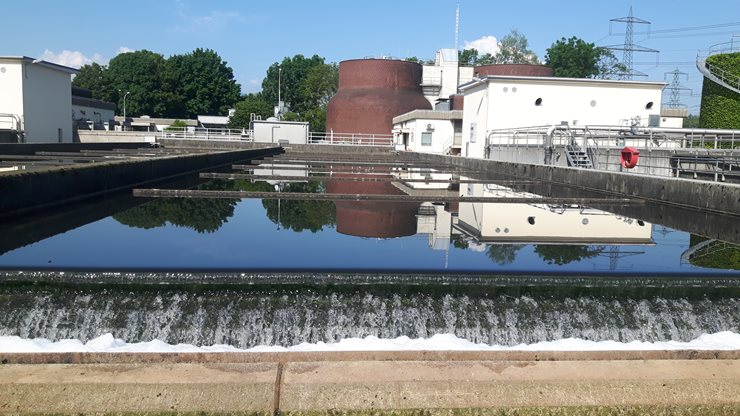
Hohenems Region Association Sewage Treatment Plant: Wastewater treatment with two-stage biology/activation (hybrid process)
For over 40 years, the Hohenems Association Wastewater Treatment Plant has been treating municipal wastewater from the city and four surrounding communities. As early as 1981, there was a significant and sustained improvement in water quality in the Koblach Canal and Lake Constance.
Since the plant was expanded in 2004–2006, wastewater treatment has been carried out using a two-stage activated sludge process (developed by Dr. Matsche at the Vienna University of Technology) that is optimally designed to break down pollutants (carbon, nitrogen, phosphorus, etc.). Sludge stabilization is achieved through an anaerobic digestion process.
Treatment process:
The Hohenems regional wastewater treatment plant is a three-stage treatment plant with two lines.
1. Mechanical treatment stage Screening system: Removes large solids such as hygiene products, leaves, and paper.
Combined sand/grease trap: Separates mineral substances (sand, gravel) by sedimentation.
At the same time, fatty components float to the surface and are also separated or fed into the digestion tower.
2. Biological cleaning stage Aeration tank: Microorganisms break down dissolved organic substances (carbon compounds).
The addition of precipitating agents breaks down the phosphorus load as far as possible.
Secondary clarifier: The activated sludge flocs settle, some of which is returned, while the surplus is further treated as sewage sludge.
Nutrient elimination: In extended biological stages, nitrogen and phosphorus are specifically removed (e.g., by special bacteria or the addition of chemicals).
3. Chemical-physical treatment stage: Precipitation: Addition of chemicals (e.g., iron or aluminum salts) to precipitate phosphorus.
Flocculation: Small particles are combined into larger flocs to improve sedimentation.
4. Trace substance removal (fourth treatment stage) for the removal of e.g. drug residues from around 2033.
Methods: Ozonation and downstream filtration or adsorption by activated carbon, either as powder or granules.
As an alternative, there is the joint trial in 2026, i.e., a combination of precipitant and activated carbon (Danube PAC Aquaclear).
5. Sludge treatment: The excess sludge produced is dewatered via a sieve belt and fed into the digestion towers. The sludge is decomposed by anaerobic bacteria, producing digester gas. This energy source is used to generate electricity and heat. As a result, the ARA's energy coverage rate is around 75 %.
Dewatering & recycling:
The digested sludge is thoroughly dewatered using a chamber filter press. The sewage sludge produced in this way is collected and mainly sent for incineration.
In the future, the phosphorus content of the ash will be recycled and processed into a marketable product.
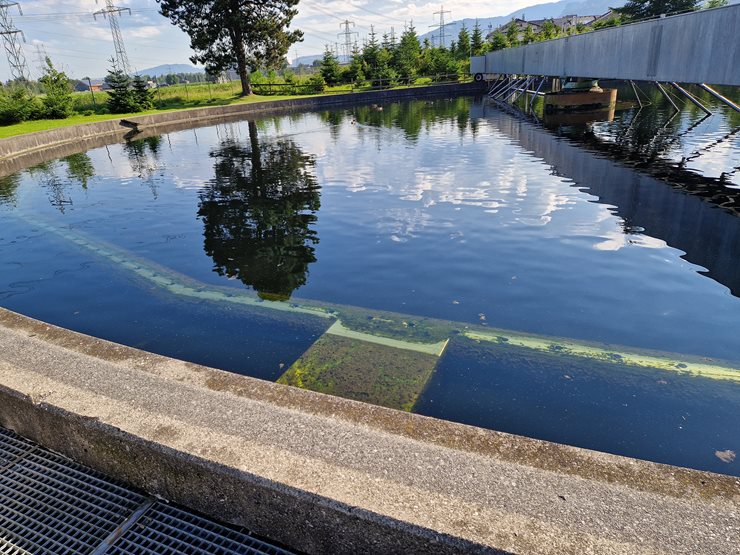
The catchment area of the Hohenems Region Wastewater Treatment Plant
Wastewater treatment for the entire region – consisting of the five municipalities of Hohenems, Götzis, Altach, Mäder, and Koblach with a total population of just under 50,000 – is carried out centrally by the Hohenems Region Wastewater Treatment Plant. Around 6 million cubic meters of wastewater are treated annually. Discharges from commercial and industrial enterprises result in a total load on the wastewater treatment plant of around 110,000 population equivalents.
The plant is operated extremely efficiently and achieves treatment rates of well over 90%.
Sustainable wastewater treatment plant for 171,600 population equivalents
To meet the energy requirements of the wastewater treatment plant, a 175 kWp photovoltaic system was installed above the intermediate clarification tanks in 2024. As these tanks are used exclusively for sludge settling and therefore produce hardly any aerosols, the PV modules can be expected to have low stress and a long service life.
Currently, electricity generation and heat utilization at the wastewater treatment plant is provided by:
• 1 combined heat and power plant with 180 kW generator output / waste heat approx. 270 kW
• 2 combined heat and power plants, each with 80 kW generator output / waste heat approx. 120 kW each
• 2 PV systems with 15 kWp each on the roofs of the blower houses
• 1 PV system with 176 kWp, 2.5 m above the secondary clarification tank
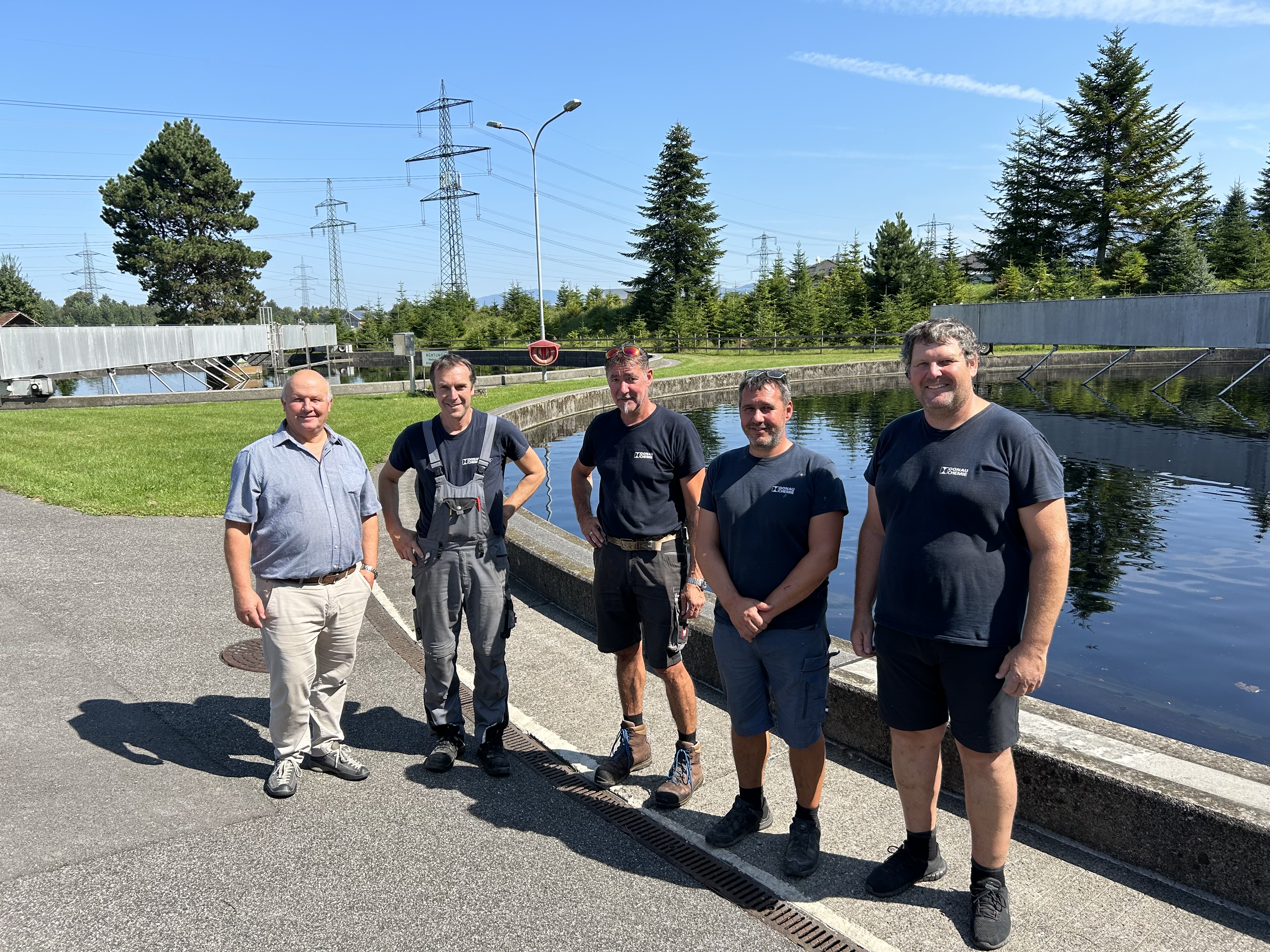 Managing Director Strobl with most of his team from the Hohenems ARA region
The future of wastewater treatment: DONAU PAC® AQUACLEAR
In view of future legal requirements and increasing demands regarding the fourth treatment stage, the Hohenems wastewater treatment plant plans to test the innovative DONAU PAC® AQUACLEAR product from Donau Chemie Wassertechnik.
The particular strength of DONAU PAC® AQUACLEAR lies in the removal of micropollutants (e.g., pharmaceuticals, cosmetics, pesticides, and other chemicals) while simultaneously precipitating phosphate.
Further advantages:
• COD reduction (chemical oxygen demand)
• Odor inhibition
• Optimal breakthrough protection for GAK filters
• Peak coverage during rainfall events
• Positive effects on the treatment performance of the wastewater treatment plant and sludge properties
DONAU PAC® AQUACLEAR can be integrated into existing treatment processes with minimal effort. The technology achieves very high treatment performance with minimal investment costs and reliably calculable operating costs.
Conclusion: Wastewater treatment in Hohenems
The Hohenems region association wastewater treatment plant combines a powerful two-stage activated sludge process with a future-oriented and renewable energy supply. The result is sustainable, economical, and environmentally friendly wastewater treatment that ensures long-term water quality. DONAU PAC® AQUACLEAR can make a significant contribution to this.
If you would like to learn more about modern solutions for optimizing municipal wastewater treatment plants, visit us at donau-chemie.com/wassertechnik or contact us via the usual channels.